27 March 2017

OP JINDAL ADMISSIONS HEAD: THE SECRET TO HAPPINESS, By Rishina Tyagi and Shubhi Raghav Gr 11

Our Director, Dr. Advani described him as a foodie, a cricket enthusiast and an Arsenal lover in her introduction. Arjun Puri has certainly travelled the world, explored his own capabilities, and inspired us to do the same.

During his childhood, his dislike for math led him to realise that everybody is good at something and for him that thing just wasn't math. He gradually came to the conclusion that he liked humanities. Unfortunately, at that time his all-boys school did not have the option of humanities, as it was considered a girl’s subject. This came as a shock to us, though we were aware of gender bias in education. He of course strongly disapproves of such categorisation in education and this had all of us nodding in agreement.

Mr Puri went on to attend 4 different colleges until he found the right one – St Andrews; the one which allowed him to truly pursue his passion and he, in this discussion, encouraged us to do the same. He has gone through 6 different careers in his life, starting with being a successful investment banker with Merril Lynch. Then, one day, he left his $250,000 job to go to a small village in Bihar to teach for Rs 4000, which shocked everyone in our classroom. The time he spent there changed him as a person, made him aware of the difficulties endured by so many people, and helped him burst the bubble of so-called happiness. He told us how creating opportunities for other people by letting them be extraordinary in their own way is one of the greatest joys he has ever experienced.

We ourselves have made small contributions to help society, and thus related to what he said. His views on education being the true privilege and not material wealth also left a deep impact on us.
Lastly, we asked him questions like what was the reaction of his parents for his unconventional way of living. He described them as supportive throughout his journey, no matter what decision he made. In the end, he left us with an inspirational message - you may be uncertain but if you do not take risks then you will never know.

'HOW WE ORGANIZE OURSELVES' - The PYP Grade 5 Exhibition by Ms. Kriti Nigam Form Tutor Gr 5

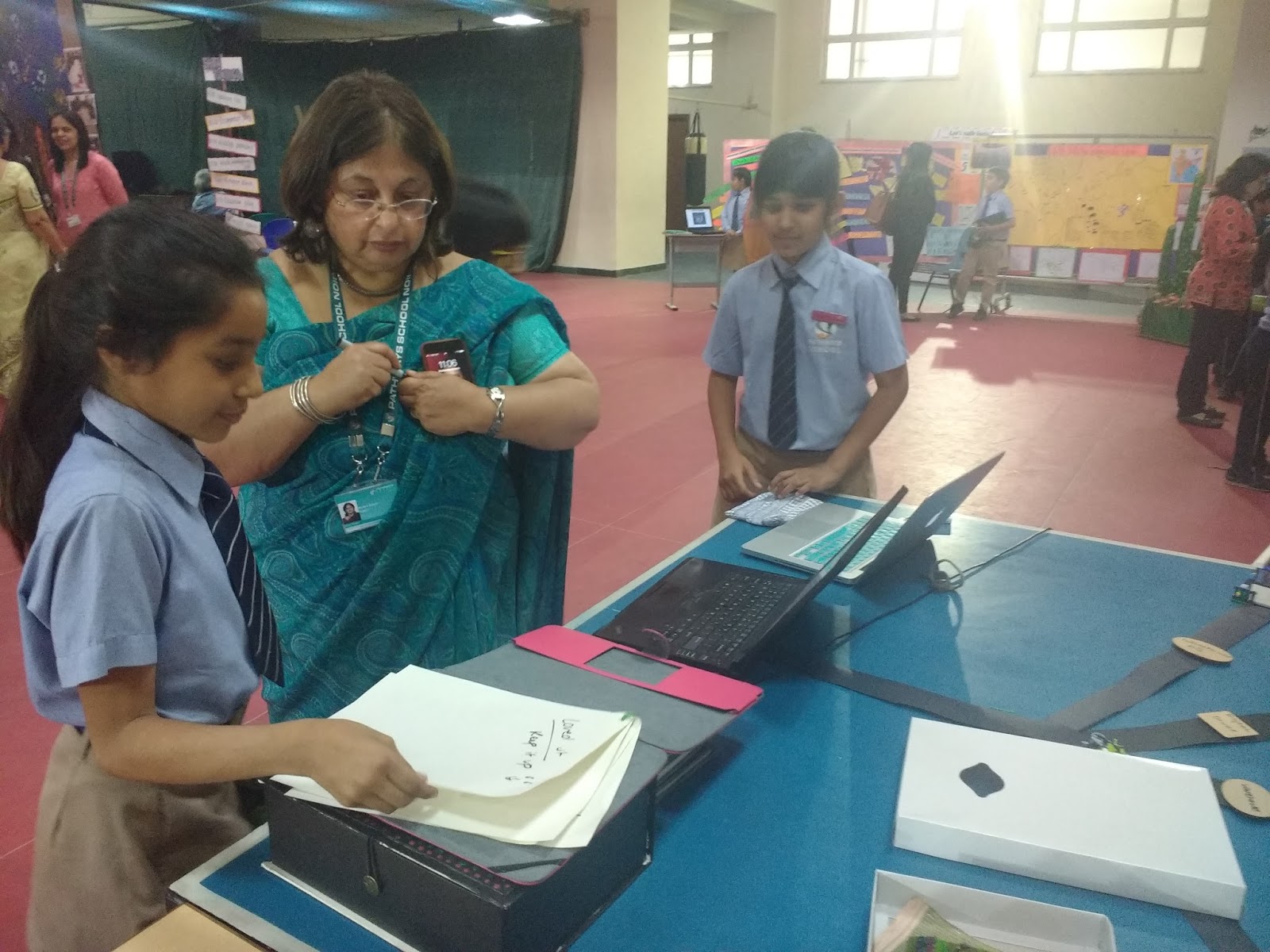
The children of Form 5 showcased the culmination of their journey throughout the Primary Year Program (PYP) through an exhibition focused on “systems” under the inter-disciplinary theme of “how we organise ourselves”. The central idea here was “manmade systems impact the way communities organize and functions”.
The children brainstormed on the different systems around them and shortlisted nine systems they wanted to inquire into - technology, waste management, wildlife protection, education, healthcare, NGOs, transportation, religion and E- commerce. They explored these various systems by visiting the relevant organisations, interviewing people, research etc, and understood the numerous problems afflicting these systems as well as the consequences of their inefficiencies. Children gathered real time data to make inferences and come up with solutions.

This inquiry process resulted in ‘action” by children, ranging from sensitization to cyber-safety and digital citizenship, collecting money for SPCA through sales from a website created by children, to a food sale and children collecting papers to recycling. Children also manufactured recycled paper and gave paper to each group to create their own banner. They also sensitized people about carbon footprints and the process and advantages of composting.

Not only did students spread awareness on NGOs supporting animals but also the various organisations working with the under-privileged and providing free education. The initiative to sensitize children about having nutritious food emerged beautifully through Drama for different audiences. The performances this year emphasized the cause each group supported and emerged through different medium of expression. The group performance was a percussion piece with a difference. The performance was special because children used discarded and waste materials and organized the sounds and notes to create a beautiful melody.


The children worked hard and their work was appreciated by one and all. The children later reflected that they themselves needed to be organized in their habits and be on model behavior to help maintain these systems, which are the key to a smoothly functioning society.

Career Day at Pathways School Noida, By Ms. Deblina Chakraborty, College Advisor

It is a beautiful thing when Passion and Career meet in our lives but it doesn’t happen by chance or even by a stroke of luck. They meet at the end of many intersections – of awareness, curiosity, reflection and introspection.

The Career and College Guidance Department at Pathways School Noida organized Career Day on February 2, 2017 to understand and reflect on the different career journeys of four eminent professionals from the Pathways Noida parent community.

Mr. Varun Tuli, a leader in managing financial and legal functions of entities in many parts of the world, shared his unique journey of how he handled multiple responsibilities of a family business as well as a career in Banking and Business Analysis and spoke about the way he identified his passion in financial and management accounting and delved to acquire a deeper understanding of this, eventually extending his expertise to work with global entities. 

Dr. Ashutosh Sinha has specialized in Paediatric Critical Care and shared his story of developing his interest and passion. He worked with immense rigor during his years at school and pursuing his interest propelled him in the direction of his specialization. He spoke about the expanding opportunities in the field of Medicine, life beyond the glamour of his profession and shared anecdotal experiences from his career.

Twenty-two years ago, it was a dream to follow one’s passion to make a career in Graphic and Creative Designing. Mr. Vikas Tomar, who focusses on immersive infotainment, brought out the future of the IoT (Internet of Things) domain and showed how this will affect every aspect of life. He shared the story of his journey from working on special effects with an Apple authorized digital studio, through various prominent milestones, to reach his position of Entrepreneurship in the Infotainment Industry.

Mr. Praveen Swami brought out some scenes from the newsroom and questioned myths that we may have about journalists. Students were thinking about the hard work and the intrinsic qualities needed for one to become a journalist. The fact that the media is meritocratic and one cannot survive on a brilliant piece of work for long, that it is not all fun that makes for success here and that the traditional distinctions between print, video and online journalism are fast collapsing raised many questions in the minds of students and they asked questions on what they should expect and how they can explore this path through Internships and Observations in this field.

The students spent two hours trying to understand the lives of these professionals. Through their stories they learnt that one has to go through rejections and failures before they succeed, that there can be no short cuts to success – the secret is to do what one enjoys most and that will make the long road seem shorter and that there is a world of new opportunities that awaits them. 

CODING AWAY TO GLORY by Aryaman Dewan Gr 11 and Ms. Sana Noor Primary ICT Teacher

Coding in the simplest of terms, is telling a computer what you want it to do.

So writing a code is like telling the computer what to do. Coding is integral to every website, app, calculator, or any digital product. Slowly jobs, which are not related to computer science like banking or journalism, are going to require basic knowledge of coding too.

“Everybody should know how to program a computer as that teaches us how to think!”  says Steve Jobs.

In the coding week held from 6th to 10th of Feb students as well as parents participated in a number of activities.

The KG kids and older were introduced to the concept of coding through games. Here one player was blindfolded and the other was supposed to guide the partner to a specified destination by giving instructions. This game made it completely clear that coding is nothing but instructions to the computer, and it’ll do whatever we want it to.

While grades 4 and 5 were introduced to Scratch Programming, Primary teachers too tried their hand at coding and got hooked.  Yet the highest point of the week was the Parent-Hour of Code, where about 40 parents enthusiastically participated with their children and attempted coding for the first time. It was a delight watching all the adults as eager as children, trying to figure out the right path or the correct conditional statements to reach the destination at each level.


The seniors with their inter-house debugging challenge, the middle school with their robotics competition, the STEM challenge, and the finale of games, robots and posters made at home and showcased at school - truly it seems Pathways Noida spent a glorious week coding away to glory.

Working With Habitat For Humanity by Rishina Tyagi Gr 11

Each year, students from Grade 11 have a CAS (community action support) trip to Savda Ghevra in association with Habitat for Humanity India. Savda Ghevra JJ Resettlement Colony is one of Delhi’s most recently established resettlement colonies, and is located on the outskirts of Delhi. It was established in 2006 to allocate land to the displaced residents who were from Yamuna river bank and alongside Indira Gandhi air strip. It was done then to accommodate space for the 2010 Common Wealth Games that India had successfully bid.

Stepping out of the bus, one of the first things we say was a huge tank filled with water and a line of people in front of it. Miss Indira, one of our teachers in charge, later told us how there is a shortage of water there and that everyone carries cards to pay for that water. The idea itself was so shocking and surreal to us, especially since we were provided a large number of bottles of water for our 2 hour stay there. We were split up into groups of 8-9 and assigned a house to paint, and on the way to the house assigned to us, I noticed something else that shocked me. All the roads, except for the main road, were insanely narrow and the houses were all cramped against each other. In each house, there were at least 6-7 people, spilling out on the streets and staring at all us in our masks, gloves and brushes in hand.

We started by painting the inner room on the ground floor; there was no light in there, only a cot propped up on bricks, a small dresser and a stool. With only the lights of our cellphones, a few brushes and baby pink paint, we painted their houses and tried to brighten up their lives. Afterwards, we got to interact with some of the people who lived there. They talked to us about their daily lives and the obstacles they faced. Some of them worked to empower the women in the society by teaching them things like sewing and saving money to contribute to anyone going through hard times.


These people with barely any education and so little to their name still give so much to their community; their words and actions truly inspired me and everyone else. Our short time in Savda Ghevra taught us so much about community, compassion and kindness.

‘Exploring through an obscure world’ Our art trip to the National Gallery of Modern Art, New Delhi by Prachi Sharma, Grade 9

Our trip to the National Gallery of Modern Art was thought provoking and fun at the same time.
Jitish Kallat’s exhibition of ‘Here After Here’ showcased various art forms and styles and mediums such as steam, paint, dental plaster, black lead, resin, steel, etc. He had also showcased the speeches of late exceptional leaders such as Mahatma Gandhi and Jawaharlal Nehru in the form of art. The most astounding art piece was of the ‘fog screen projection’, which exhibited a letter being typed in steam. It had various components involved such as a

projector, real steam, a typewriter. The author also created real life visual effects with the help of a projector in order to communicate the very idea of how we observe. Each and every piece of his had some story or message to share in order to make an impact on the audience and show how he looks at the world. The color scheme differs in each of the art pieces produced by the artist, be it still life or infrastructural art. Some of the art works also portrayed the artist’s scientific thought process, like the piece in which police officers from different countries were working; in total there were 24 pieces just like the 24 hours of a day.


Our trip to the art museum not only helped us explore different mediums of art but we also gained a little more on how we can apply our understanding to art. For instance it was incredible to see a letter being typed on steam along with pictures that the author took to share his idea of an issue. Jawaharlal Nehru’s speech or Gandhi’s, too were depicted as art with the use of different mediums. It was a great learning experience.


United We Stand Divided We Fall by Udai Taneja & Rishab Menon 8 C

Division and inclusion.

Division is present throughout the world. Here in India, it goes back centuries in the most distinctive form, caste. Walls too are present everywhere - from Israel to Mexico. President Donald Trump wants to build a wall to separate Mexico and the USA. Israel has built walls to separate itself from Palestine. These leaders claim that building walls are preventing major wars but if we look at the research provided by ‘theguardian.com’, it seems Mexicans have been living both in America and in Mexico for decades without having any trouble. So one wonders, why build walls to separate people if they pose no threat to the countries?

This global divide is caused by different mindsets in the world. Different people have different opinions about different circumstances and these opinions cause a major rift in the unity of people. Some believe that women should not be educated while others, that blacks are inferior to whites. A major difference between the USA and the USSR caused an ideological war, that of communism and capitalism. The division of Germany into West and East is another example.

Even though there are divides, the world over, people have also destroyed both mental and physical boundaries. Take the Berlin wall for example. This wall had divided people for so long but in the year 1989, people destroyed it. Nowadays there, people are more open-minded. There are other examples of progress too. For example, now the girl child is more widely accepted, supported and even educated. In certain pockets racial discrimination too has come down making it a better place.

 This is what Ms Urvashi Butalia brought out through her interactions with us on 24th February. She rightly said referring to Pakistan, ‘You can't consider a country an enemy’. Ms Butalia argued that Pakistanis look like us, in so many ways live and think like us, how can we call them ‘the enemy’? This is a man-made border and a fictitious enemy. Supposedly Pakistan became home to Muslims, and India to Hindus during partition. People were told that their only identity was their religion and the other religion was their enemy. Similarly, the Northeast borders were created during British rule. Many of us label people from the Northeast as foreigners and Nagaland once demanded independence from India. So often two different communities seem unable to live together but why? Surely, the real solution is not to live apart but to live together.

We concluded Borders aren't always bad; it’s a question of how they are viewed and written about. Perspectives and opinions are often one-sided and prejudiced. Needless to say leaders could definitely play a positive role in bringing people together but the questions remains: do we as ordinary citizens have absolutely no control over how we view those on the other side of our own borders?

India Art Fair Visit at NSIC Exhibition Grounds, Okhla Industrial Estate, New Delhi Anoushka Nalwa, Grade 11


Visiting to a grand art hub is an exciting experience. On 5th of February, all senior school art students visited the India Art Fair, South Asia’s modern and contemporary art fair, which seamlessly captured exactly what art meant to each one of us. The whole experience of observing art pieces from all around the world not only widened my horizons, but it also motivated me to create art work that not only looks beautiful or aesthetically rich but also relates to its viewer in some personal way. During the exhibition, I absorbed various perspectives of the world and understood how beauty is just a technique to capture attention, while the main objective of our work should be to move people and offer our perspective on the issues of the world.

During the trip, we also got to interact with a few artists and talked to them about their artistic practices and methodology. Furthermore, the whole experience of getting to view art pieces from around the world helped us pickup tons of new techniques and helped us understand the purpose of art better. The whole experience altogether, helped us understand different art pieces and the curatorial practice better while even introducing us to new art forms.

6 February 2017

From the Director's Desk

Despite all the upheavals in the world outside our walls this has been a good start to the year. In the three weeks since school started our students have done us proud.
  
A group of middle and senior school students competed against 22 other schools for the World Scholars Cup and all our teams qualified for the next round which will take place in either South Africa or Greece. Many students also won individual medals
   
 Junior and Middle school Golf students entered for the Junior Golf tournament in Noida and won 4 gold and 5 silver medals
  
 A group of 35 students representing the tennis, swim and basketball teams have gone to the Association of International Schools (TAISI) interschool tournament competing against over a thousand students. 34 students along with 4 teachers participated in TAISI Inter IB Schools National level sports competition held at Bangalore The Inventure Academy . Overall 1175 participants participated in the event from various IB Schools. Students represented the school in sports like Athletics, Swimming, Basketball, Soccer, Table Tennis, Badminton and Tennis. Our students secured 2 Gold, 3 Silver and 5 Bronze in Athletics and Swimming.

Musicians distinguished themselves in an inter-school non competitive event at The British School.

Recognising Academic Achievement


Students who excelled in the first semester were invited to a special event Dessert With the Directors where in a formal setting they conversed with the school executive management– the Jain family and Dr Datar. Over dessert they were able to discuss their views and put questions to the Directors of the school.


Careers Day

Thank you to the parents who came into school to share their experience and lives in different careers with students from Grade 9 up. We were happy to welcome Mr Tuli who spoke on banking and business risk, Mr Tomar on animation and gaming, Mr Swami on journalism and Dr  Sinha on medicine. They provided an invaluable insight to students.

Staff Development
   Since December 60 teachers have achieved Microsoft certification as Microsoft Educators. 6 teachers have been appointed examiners by the IB for the MYP and 4 for the Diploma programme.  

     I am delighted to share that Dr.  Kaul, the IGCSE Coordinator and HoD – Social Science has been appointed as a global Team Leader for Geography  and joins the elite team of Dr. Garrett Nagle and Lucy Greenslade, the other two global leaders. We are proud at how many of our Faculty are now recognised by the IB.


Four teachers are attending the South Asia IB Schools Association (SAIBSA) conference in Mumbai. Three of them, Ms Pilar Cinca, Ms Pallavi Dwivedi and Ms Anshu Sharma,  will be leading workshops at this session.  
        
The Administration leadership team from all 3 Pathways school met together for a two-day workshop on good practice.
  
Looking ahead, we will be having a number of important training sessions for groups of staff this month.

1. Crisis Management Response: on Disaster Response, Terror Threat, Fire Fighting & Crisis Response.

2. Theatre In Education:  A workshop on Theatre in education for 30 teachers across primary & secondary. The facilitators Geoff and Anne Readman are visiting from the UK and will be running workshop sessions with Grade 4, Grade 7 &Grade 11 and a training for teachers across the school. Dr Readman is a Specialist Teaching Consultant in Drama Education. He has previously worked as an actor-teacher, primary and secondary teacher, drama advisor and university lecturer for teacher training. He has published articles and a BBC book on primary drama. Anne Readman is an experienced primary drama practitioner who has developed drama initiatives in both in the UK and Hong Kong.

3. Academic Leadership Retreat: a weekend retreat and training for all coordinators and Heads of department

Student Community Service
  
 In January the new Interact student leadership was welcomed at a special ceremony, marking our ongoing commitment to intervening to improve the world. They organized a contingent for the Cansupport walk seeing widespread participation from parents and students.
     
Grade 9 & 10 students ran a health checkup with doctors for the children of Sai Bal Sansar school, They also arranged a sports event for them.

MYP students had a Readathon to both encourage reading and to raise funds through sponsorship of the pages they read. You can get a sense of this event by clicking on this link 
https://youtu.be/EZEZ-N1GdJY


Coding Week
In the upcoming week we introduce Coding Week to all students from Grade 2 up. The challenge has been thrown open to parents too, to come and learn coding. No previous experience is necessary.

Medical dept. update
We are pleased that a fully equipped school ambulance is in place on the school premises. The Interact club will also be running a blood donation camp during the PTM on 18th March and parents are urged to come forward for this important cause. More details will be forthcoming.

Dr. Shalini Advani
School Director

From the Primary School Deputy Principal, Mrs. Aruna Jha

“Alone we can do so little; together we can do so much”  ― Helen Keller

Primary school begins the new semester with fervor of happiness and positivity to make it another fruitful term. Reflecting on the semester gone by I would like to thank our parent community for an enthralling Christmas carnival. The carnival bore the festive spirit and has been a true example of harmony and bonding. The innovative game stalls, food counters and the exciting activities portrayed a true sense of collaboration visible to one and all. This has been possible because   every member of the school community has been selflessly extending themselves for the benefit of students who are the heart of Pathways fraternity.

After the winter break everyone had done their prior planning and were once again enthused to learn, contribute and share. The children quickly settled into the new term and there is a happy buzz through the school which is good to see.

To consolidate student learning, parents have always been very supportive. Sparing precious time parents have been reinforcing our reading programmer from KG to grade 3. This has been welcomed wholeheartedly by the students and are eager to read with them.

Collaboration helps transform the process of learning.  An orientation for parents of Grade 5 to understand the objective of PYP exhibition has been appreciated. Eagerly   parents have been volunteering to collaborate with groups of students inquiring on Human made systems. The process for
many is emerging to be very nostalgic. An attitude of learning from students and parents supporting and guiding them in their inquiry is in true sense humility personified. Parents and students   once a week are reflecting on the progress of the inquiry with respective groups and suggesting changes and seeking opinion both ways to make it an experience worth remembering.

Grade 4 inquiry on Migration has provided students an opportunity to gather first - hand information from Brigadier Singh.   He kept his young audience gripped with personal anecdotes about his experiences of the largest mass migration between India and Pakistan. The interaction led students question further to understand the plight of refugees and reasons for migration. Interacting with the famous author Mr. Deepak Dalal led fourth graders make interesting connections between human migration and bird migration majorly for survival.

Besides a variety of learning engagements in school we continued celebrating important events around the world and this time it was India’s 68th Republic day. The day has been   celebrated across school in the primary and senior school assembly. Teachers decoding important constitutional terms through roleplays and grade 4 students identifying learner profiles with experiences of Gandhiji led all to recognize the value of celebrating Republic day.
In the lower primary all students and teachers are passionately working for the Rhyme time day. Editing the script, designing costumes, recording   music and working on stage performances has been   the focus in. They are working hard to prepare a show that matches up to everyone’s expectations.


Spirited as we are, grades across primary are also gearing for Readathon with a host of engagements planned to make reading enjoyable and enhance skills for reading effective. Teachers at Pathways need to continuously evolve and what better example of the many MIE certifications earned by our teachers. In the coming weeks   many opportunities are designed for the students to show case their understanding of various spectrums in multiple ways and we continue to motivate students to initiate action and grow.